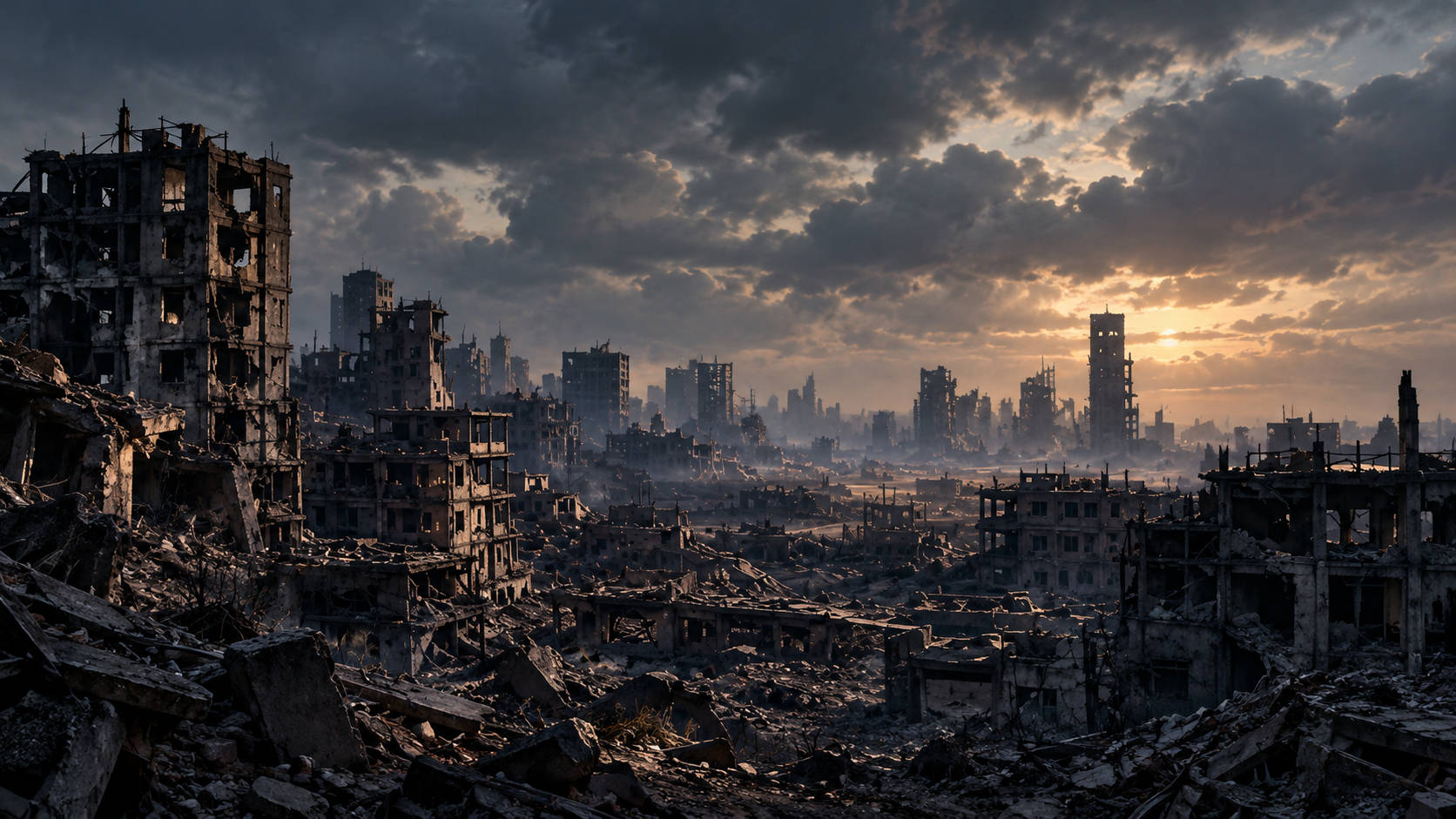
Humanity speaks endlessly of peace. Its enthusiasm for watching other people fight suggests that certain conditions apply.
Humanity has a remarkable affection for peace. It celebrates peace treaties, builds monuments to peace, awards prizes in its name, and invokes it in nearly every significant international gathering. Politicians promise it. Religious leaders pray for it. Ordinary citizens declare their commitment to it with considerable sincerity.
Yet war remains one of humanity’s most enduring preoccupations, and not merely among those who make their living conducting it.
There is something deeply contradictory about a species that claims to despise violence while demonstrating such extraordinary enthusiasm for the organized destruction of its fellow members. Every new conflict produces the familiar declarations of regret, concern, and solemn determination to avoid further bloodshed. These declarations are frequently followed by spirited discussions of which side should attack, how aggressively it should proceed, and what level of destruction might finally persuade the other side to surrender.
The contradiction becomes less mysterious when one considers who is doing the discussing.
For much of humanity, war is something that happens somewhere else, to someone else, at someone else’s expense. It arrives through television screens, social media feeds, political speeches, and carefully edited footage. It is experienced as a sequence of developments rather than a sustained human catastrophe.
From this distance, war can be remarkably entertaining.
The Privilege of Watching
Modern civilization has made it possible to observe warfare with extraordinary immediacy while remaining almost entirely insulated from its consequences.
A missile strike can be watched moments after it occurs. An armored column can be followed across digital maps. Military analysts explain advances and retreats, compare weapons systems, identify strategic vulnerabilities, and speculate about the next offensive. Commentators debate whether an attack was sufficiently forceful or whether a more decisive response is required.
Audiences react with excitement, outrage, anticipation, and occasionally open celebration.
There is remarkably little distance between the language used to discuss military operations and the language used to discuss competitive sports. One side is winning. Another is losing. Commanders are praised for aggressive play. Failures are examined with the confidence of spectators who have never been required to make a comparable decision.
The difference, of course, is that the consequences are not confined to a scoreboard.
An advancing front means that people are being killed, homes destroyed, and communities emptied. A successful strike may mean that a target has been eliminated, but it may also mean that a family will spend the next several days searching hospitals for someone who will never arrive.
These details are less easily accommodated within the excitement of a military breakthrough.
The spectator sees the explosion. The person beneath it experiences an entirely different event.
Yet both are said to be witnessing the same war.
War Offers Something Peace Cannot
Part of war’s attraction lies in its ability to simplify a complicated world.
Human affairs are notoriously difficult to understand. History produces overlapping grievances, incompatible narratives, competing interests, and moral questions that rarely submit to straightforward answers. Political problems require patience, knowledge, negotiation, and some willingness to recognize that one’s own understanding may be incomplete.
War offers a more satisfying arrangement.
There are sides. There are objectives. There are enemies. There is the possibility of victory.
Even when a conflict has complicated origins, the public discussion surrounding it often becomes an exercise in reducing complexity. The distinction between understanding an opponent and excusing their behavior disappears. Compromise becomes weakness. Restraint becomes cowardice. Questions become evidence of disloyalty.
The transformation is emotionally useful.
War provides a sense of purpose and belonging that ordinary politics struggles to reproduce. It invites individuals to participate in something larger than themselves without necessarily requiring them to contribute anything more demanding than approval. Supporting a cause becomes a demonstration of virtue. Condemning an enemy becomes an expression of identity.
There is also the powerful satisfaction of imagining an opponent defeated.
People may sincerely oppose suffering while taking considerable pleasure in the humiliation of those they believe deserve punishment. They may condemn violence in principle while welcoming it enthusiastically when directed against an approved target.
In this arrangement, violence is not considered objectionable in itself. Its morality depends heavily on who is receiving it.
Humanity has developed an impressive vocabulary for maintaining this distinction.
Our violence is necessary. Theirs is barbaric. Our destruction is unfortunate. Theirs is evidence of depravity. Our anger is justified. Theirs is dangerous.
At some point, the desire for peace becomes indistinguishable from the desire to see one’s enemies rendered incapable of resistance.
This is not quite the same thing.
The Strange Geography of Compassion
Human compassion is genuine, but it is not always distributed consistently.
A destroyed neighborhood can provoke grief, fury, or indifference depending on where it is located and who lives there. The death of a child may be understood as an intolerable tragedy or absorbed into an argument about military necessity. The suffering of one population is documented in intimate human detail, while the suffering of another is reduced to estimates, qualifications, and strategic considerations.
This does not necessarily reflect an absence of empathy. It reflects the ease with which empathy can become conditional.
We are extraordinarily sensitive to the suffering of people we recognize as belonging to our own community, nationality, religion, or political cause. Extending that concern to people identified as opponents requires a more deliberate effort.
War actively discourages that effort.
An effective wartime narrative must establish not only why our side deserves support, but why the other side deserves defeat. Once that distinction becomes central to collective identity, acknowledging the suffering of an adversary can feel like a betrayal.
The enemy must remain sufficiently abstract for violence to remain emotionally manageable.
A soldier becomes a uniform. A civilian becomes a demographic. A city becomes a military objective. An entire population becomes associated with the decisions of its government or armed forces.
The process makes large-scale suffering easier to justify because it becomes increasingly difficult to recognize individual human beings within the categories being discussed.
And once people have become categories, their destruction can be discussed with remarkable composure.
Peace Is Less Satisfying Than Victory
There is another problem with peace: it rarely provides the emotional conclusion people want.
Peace is frequently imagined as the natural result of one side prevailing completely over another. The defeated surrender, the victorious celebrate, and the conflict ends with sufficient moral clarity to reassure everyone that the suffering accomplished something worthwhile.
Actual peace is generally less cooperative with narrative expectations.
It may require negotiations with people who have committed terrible acts. It may leave legitimate grievances unresolved. It may demand concessions that feel humiliating, arrangements that seem unfair, or guarantees that neither side entirely trusts.
Even when an agreement succeeds, its achievements are often difficult to celebrate.
A battle produces dramatic images. A successful ceasefire produces the absence of images.
A victorious army can parade through a capital. A successful diplomatic intervention may be remembered only as a crisis that never happened.
The emotional imbalance is considerable.
War produces visible events. Peace requires preventing events from occurring.
A military commander can point to territory captured or targets destroyed. A diplomat may spend months preventing an escalation that the public will never know was possible. A government that mobilizes for war can demonstrate resolve through movement, expenditure, and spectacle. A government that prevents war may be accused of accomplishing nothing.
Humanity has never been particularly enthusiastic about rewarding the prevention of disasters it did not get to witness.
The result is a civilization in which preparing for war is treated as an expression of seriousness, while preparing for peace is often regarded as a hopeful aspiration.
Weapons are purchased, forces assembled, and contingency plans refined with considerable institutional discipline.
Peace, meanwhile, is encouraged.
The Comfort of Other People’s Sacrifices
Perhaps the most revealing feature of humanity’s relationship with war is the enthusiasm with which people recommend sacrifices they will never personally make.
Calls for escalation are easy to issue from a comfortable room. Demands for decisive action carry little immediate risk when the individuals making them are safely removed from the consequences.
The language is familiar. Someone must stand firm. Someone must teach the enemy a lesson. Someone must demonstrate that aggression will not be tolerated.
Someone, invariably, must do something.
It is worth noticing how often that someone is another person.
The soldiers expected to carry out these demands may be young people with families, private ambitions, and limited influence over the political decisions that place them in danger. The civilians exposed to retaliation may have had no meaningful role in creating the conflict. Their lives become the material through which distant audiences expect geopolitical principles to be demonstrated.
This does not mean that all military action is unnecessary or unjustified. Aggression exists. States and communities sometimes face threats that cannot be resolved through goodwill alone. Defending people against violence may require force, and refusing to acknowledge that possibility would be another kind of moral evasion.
But accepting that war can sometimes be necessary is very different from becoming enthusiastic about its conduct.
Necessity should inspire gravity, not excitement.
The person who recognizes that fighting may be unavoidable should be among the first to acknowledge its terrible costs. Instead, public discussion often rewards confidence, aggression, and certainty, while treating hesitation as a defect.
There is a disturbing ease with which people can become impatient for violence when they expect someone else to carry it out.
The War Must Continue Until Peace Is Achieved
One of humanity’s more durable political inventions is the idea that peace can be secured through one final, sufficiently decisive application of violence.
The reasoning is attractive because it promises an end to uncertainty. If the enemy can be defeated completely, the conditions that produced the conflict will supposedly disappear. If enough force is applied, resistance will become impossible. If the outcome is sufficiently overwhelming, future violence will be prevented.
History offers ample reasons to question the reliability of this arrangement.
Military victories can end wars. They do not automatically resolve the fears, grievances, ambitions, and institutional failures that caused them. A defeated army may cease fighting while the population from which it came remains embittered. A destroyed government may be replaced by instability. A conquered territory may become the setting for another conflict.
Violence can remove an immediate threat without producing a durable political settlement.
The distinction matters because the promise of a final victory can become an endlessly renewable justification for continued fighting.
Every new offensive is expected to make the next one unnecessary. Every escalation is presented as a means of preventing further escalation. Every additional sacrifice is defended by the sacrifices already made.
Ending the conflict before achieving the desired result can then be portrayed as rendering the previous suffering meaningless.
The dead, having no opportunity to express an opinion, are frequently enlisted in arguments for producing more of them.
Eventually, continuation becomes its own rationale.
This is one of war’s most effective methods of sustaining itself. Once enough has been lost, stopping can appear more difficult to justify than proceeding.
The original objectives may change. The promised outcome may become increasingly implausible. The human and material costs may rise beyond anything originally anticipated.
But the next offensive is always expected to be different.
What Would Wanting Peace Actually Mean?
If humanity genuinely wanted peace, its behavior would need to extend beyond rhetorical opposition to war.
It would mean accepting that peace is not simply the absence of fighting, but the sustained construction of conditions under which fighting becomes less likely. It requires security, functioning institutions, credible agreements, economic opportunity, accountability, and some means of resolving disputes without immediately resorting to coercion.
It would require recognizing legitimate grievances without automatically endorsing the methods used to pursue them. It would require protecting civilians regardless of which side they are believed to support. It would require holding allies to meaningful standards rather than treating loyalty as an exemption from scrutiny.
Most uncomfortably, it would require abandoning the expectation that every conflict must conclude with the emotional satisfaction of seeing an enemy humiliated.
Peace does not always provide the ending we would prefer.
Sometimes it requires restraint when retaliation would be popular. Sometimes it requires negotiating with people we distrust. Sometimes it requires admitting that an achievable settlement is preferable to a theoretically perfect victory purchased through years of additional destruction.
And sometimes it requires forceful resistance to aggression precisely because peace without security is not a sustainable peace.
None of these decisions is simple. All involve risk. There is no universal formula capable of resolving every conflict.
But there is a meaningful difference between approaching war as a grave possibility and approaching it as an opportunity for collective emotional satisfaction.
A society genuinely committed to peace would understand that difference.
It would be less interested in celebrating destruction and more interested in asking whether destruction was necessary. It would be suspicious of leaders who describe war as glorious, inexpensive, inevitable, or easily controlled. It would pay attention to the consequences of victory as carefully as it examines the possibility of defeat.
Above all, it would remember that war is not an abstraction, a competition, or a demonstration of national character.
It is an event that happens to human beings.
Perhaps We Do Not Want Peace Quite as Much as We Claim
It would be unfair to conclude that human beings universally enjoy war. Many people spend their lives trying to prevent it, limit its consequences, rescue its victims, or rebuild what it destroys. Those who have experienced war firsthand often understand its costs in ways that distant spectators cannot.
There is also an enormous difference between reluctantly supporting necessary defensive action and celebrating violence for its own sake.
Nevertheless, the broader contradiction remains.
Humanity speaks about peace as though it were among its highest aspirations, yet repeatedly rewards the attitudes and institutions that make peace difficult to achieve. It admires strength more readily than restraint. It celebrates victory more visibly than reconciliation. It responds more enthusiastically to demonstrations of force than to the patient removal of reasons for using it.
Perhaps the difficulty is not that humanity wants war instead of peace.
Perhaps it wants the satisfactions of war without the experience of war. It wants the unity, purpose, certainty, indignation, and triumph. It wants the reassurance that justice has been delivered and that the world has been divided into those who deserved to win and those who deserved to lose.
It wants enemies defeated, wrongs avenged, threats eliminated, and its own moral position confirmed.
And, ideally, it wants all of this accomplished at a safe distance.
Peace, by comparison, offers few of these pleasures. It requires patience, ambiguity, compromise, and the recognition that other human beings may possess fears and grievances as real as our own.
War asks us to choose a side.
Peace asks us to consider what happens to everyone afterward.
The first is considerably easier.
Until humanity learns to value the difficult, undramatic work of peace at least as highly as the spectacle of victory, its declarations of peaceful intent will remain open to question.
For now, the familiar pattern continues. The speeches are delivered. The commitments are reaffirmed. The necessity of restraint is emphasized.
And somewhere, an audience gathers to watch the next explosion.
Correspondent’s Note: Public support for peace remains enthusiastic. Personal participation in the next war is, as usual, expected to be someone else’s responsibility.