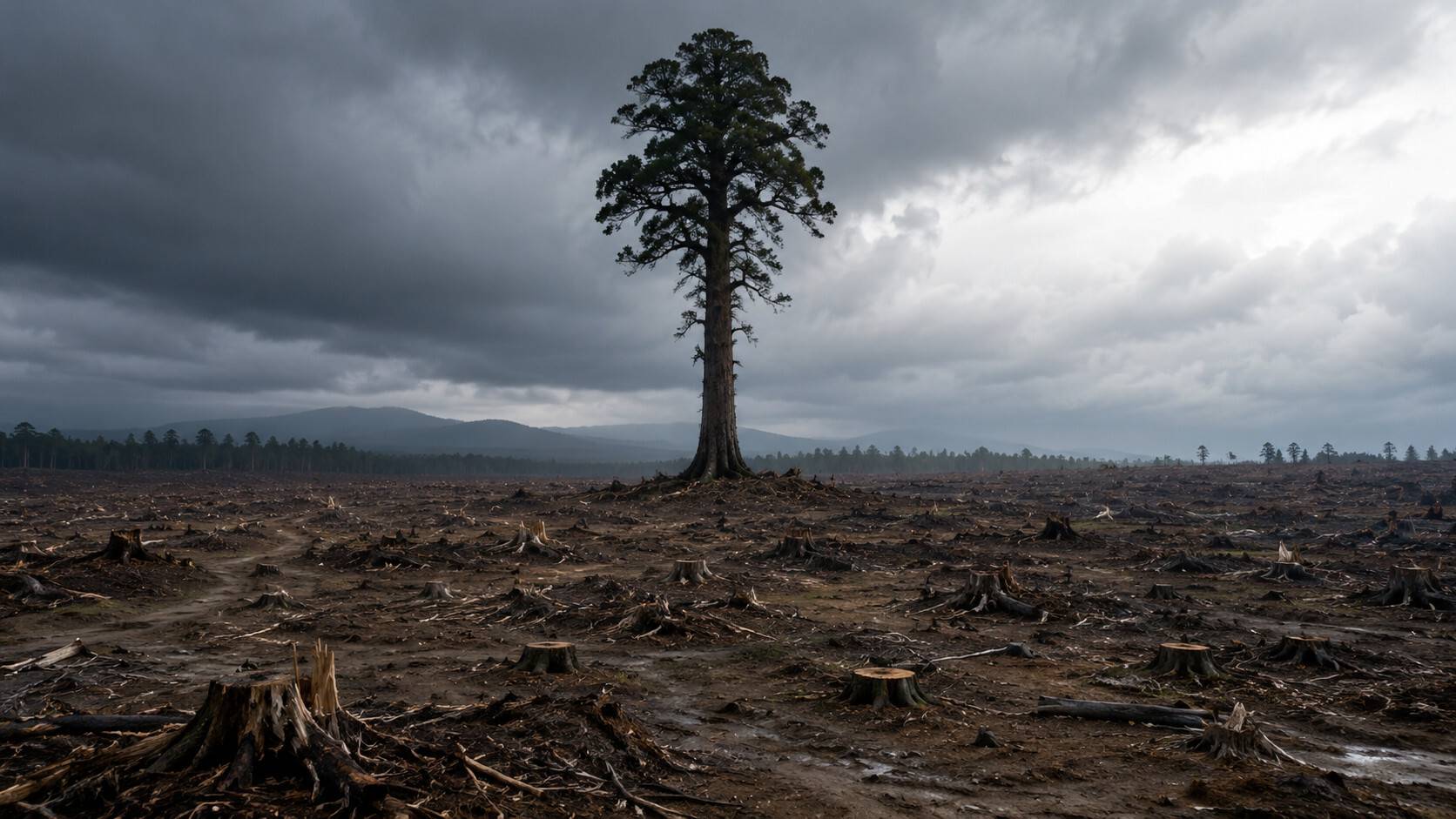
Humanity’s use of resources is one of the clearest examples of the same underlying problem: our ability to extract has outpaced our ability to govern extraction wisely.
We are very good at turning forests into lumber, rivers into electricity, minerals into machines, land into food, and fossil fuels into mobility. What we are much worse at is deciding how much is enough, who should benefit, who should bear the damage, and what must remain for those who come after us.
The central failure is not simply that humans use too many resources. Every living thing uses resources. The deeper problem is that modern civilization often treats resources as though they have value only when converted into products, profits, or growth.
A forest standing is treated as potential timber. A wetland is treated as undeveloped land. A mineral deposit is treated as idle wealth. A river is treated as unused energy. Even human attention is treated as something to be harvested and sold.
That is a very narrow way of seeing the world.
A forest is not merely wood waiting to happen. It stores carbon, regulates water, supports species, stabilizes soil, shapes climate, and possesses cultural and aesthetic value. Many of its most important functions do not appear on a balance sheet. The same is true of clean air, fertile soil, biodiversity, quiet, darkness, public space, and social trust.
Modern economies are remarkably efficient at pricing extraction and remarkably poor at pricing destruction.
We confuse availability with permission
One of humanity’s most persistent assumptions is that if something can be taken, it is available to be taken.
If oil can be drilled, it becomes a resource. If fish can be caught, they become a harvest. If water can be pumped, it becomes supply. If a mountain contains valuable minerals, the mountain becomes an obstacle between industry and the minerals.
The existence of a capability is quietly transformed into a justification.
But “we can obtain this” is not the same as “we should obtain this,” and it is certainly not the same as “we should obtain as much of it as possible.”
This is similar to the misuse of political or technological power. Humanity tends to regard unused capacity as waste. A resource left in the ground appears economically unproductive. A forest not logged appears underused. A field not intensified appears inefficient.
Yet restraint is not waste. Sometimes the most valuable use of a resource is not to consume it.
The tragedy of distance
Resource use also suffers from moral distance.
The people who enjoy the finished product are often separated from the place where the resource was extracted and from the people who experienced the damage. A consumer sees a phone, not the mine. A dinner, not the depleted aquifer. A package delivered overnight, not the fuel, warehouses, roads, labor, and discarded materials behind it.
This distance allows consumption to feel clean.
The more complex the supply chain, the easier it becomes for everyone involved to claim that responsibility lies somewhere else. The consumer did not design the system. The company is responding to demand. The supplier is meeting a contract. The government needs growth. The investor expects returns.
No single person intends the total result, but the result still occurs.
That makes resource depletion less like a deliberate crime and more like a machine made of individually reasonable decisions.
Waste is not an accident
Modern economies often depend on waste more than they admit.
Products are designed to be replaced. Fashion cycles accelerate. Repair becomes difficult or expensive. Packaging is used briefly and discarded. Advertising creates dissatisfaction with things that still function. Entire industries depend on persuading people that what they own is no longer enough.
This is not just a failure of personal thrift. It is structural.
A system organized around perpetual growth must continually turn resources into goods, goods into waste, and dissatisfaction into new demand. Efficiency may reduce the resources required for each product, but if total consumption continues to rise, the gains can disappear.
Humanity has become better at producing more from less, while simultaneously becoming skilled at wanting more of everything.
Scarcity is distributed politically
Resource scarcity is rarely just a physical condition. It is also a question of power.
There can be enough food while people remain hungry. Enough housing while people remain homeless. Enough water for essential needs while some communities face shortages. Enough energy for dignified lives while vast amounts are consumed frivolously or inefficiently.
This means the issue is not only how many resources exist. It is who controls them, what purposes receive priority, and whose needs are considered legitimate.
A wealthy society may describe itself as resource-constrained while consuming enormous amounts on convenience, luxury, prestige, military competition, speculation, or planned obsolescence. Meanwhile, basic needs remain unmet because satisfying them is considered less profitable or politically urgent.
Scarcity often appears natural even when it is socially organized.
We borrow from the future without their consent
Perhaps the most serious problem is that humanity uses resources as though the present generation were the sole owner of the planet.
We are not.
We inherited soils, forests, fisheries, fuels, species, climate stability, and accumulated knowledge that we did not create. Yet we often behave as though inheritance confers absolute ownership rather than temporary stewardship.
Future generations cannot vote in current elections, negotiate contracts, sue for damages, or refuse the terms we impose on them. This makes them uniquely vulnerable to exploitation.
We can consume resources now and leave the costs later. We can enjoy energy while leaving waste. We can degrade ecosystems whose recovery may take centuries. We can eliminate species permanently for temporary gain.
This is a profound ethical asymmetry: those making the decisions receive the benefits, while many of those bearing the consequences do not yet exist.
A civilization that claims to care about children but destroys the conditions of their future is engaged in a contradiction it has not fully confronted.
The problem with “sustainable”
“Sustainability” is an important idea, but it is often weakened into a branding term.
A process may be called sustainable because it is somewhat less damaging than the alternative, even if it still cannot continue indefinitely. A product may be marketed as green because one component changed while its overall system remains wasteful. Companies may speak of carbon neutrality while relying on accounting mechanisms that leave the underlying pattern of consumption intact.
True sustainability is stricter.
It means that a practice can continue without progressively destroying the ecological and social systems that make it possible. It requires regeneration, not merely slower depletion. It asks whether waste can be absorbed, whether materials can be recovered, whether ecosystems can recover, and whether benefits are distributed fairly.
“Less harmful” is not always the same as sustainable. Sometimes it is only a slower version of the same mistake.
Human beings are not uniquely destructive
It is important not to turn this into a simplistic condemnation of humanity.
Humans are also capable of extraordinary stewardship. Communities have managed forests, fisheries, water, and farmland responsibly over generations. People restore wetlands, protect habitats, rebuild soils, reduce waste, design durable goods, and create systems based on reuse rather than disposal.
The capacity for care is as human as the capacity for exploitation.
The problem is that exploitative systems often scale more easily. They produce immediate profits, concentrate rewards, and defer consequences. Stewardship tends to require patience, cooperation, local knowledge, and limits—qualities that are harder to reward in short political and economic cycles.
Extraction is often fast and visible.
Regeneration is slow and easily ignored.
Wealth has been defined too narrowly
Humanity’s resource problem is partly a problem of accounting.
We count what is sold, but often not what is lost. A forest becomes economically valuable when it is cut down. A polluted river can generate economic activity through cleanup. Illness caused by environmental damage creates medical spending, which may appear as growth.
This means an economy can become larger while the world supporting it becomes poorer.
A society may increase its gross output while losing clean water, fertile soil, biodiversity, community stability, leisure, health, and resilience. The numbers improve while lived reality deteriorates.
A more mature civilization would understand wealth as the ability to maintain human flourishing over time. It would count intact ecosystems, durable infrastructure, public health, knowledge, trust, and resilience as forms of capital rather than treating them as free background conditions.
The purpose of an economy should not be to move the greatest possible quantity of material. It should be to support a good life with the least necessary destruction.
Enough is the most difficult concept
The most radical question humanity could ask is not how to obtain more efficiently, but how to recognize enough.
Modern culture provides endless instruction on acquisition and almost none on sufficiency. More income, more property, more energy, more speed, more convenience, more choice, more growth. There is rarely a point at which the system says, “This is adequate. Preserve what remains.”
Without a concept of enough, efficiency simply enables greater consumption.
A person who needs little may live well with modest resources. A society that defines success as limitless accumulation can never become secure, because satisfaction is always deferred to the next increase.
This is not an argument for poverty or stagnation. Billions of people still deserve greater access to food, shelter, healthcare, energy, education, and comfort. The issue is not that everyone should consume less equally. It is that some need much more, while others consume far beyond what contributes meaningfully to well-being.
A just resource ethic would distinguish between consumption that creates dignity and consumption that mainly signals status or compensates for dissatisfaction.
What responsible resource use would look like
A responsible civilization would treat extraction as a privilege carrying obligations.
It would design products for durability, repair, reuse, and recovery. It would make producers responsible for the full life cycle of what they create. It would protect ecological systems before they approach collapse rather than waiting for definitive proof of disaster. It would measure success through health, resilience, and well-being rather than material throughput alone.
Most importantly, it would recognize that the natural world is not simply an inventory.
Humanity does not stand outside nature managing a warehouse of useful materials. We are embedded in the same systems we are consuming. The air is not an external resource. The climate is not a background setting. Soil is not an inert platform. Oceans are not an infinite disposal system.
Destroying those systems is not merely damaging the environment. It is dismantling the conditions of our own existence.
Are humans responsible enough?
Again, I would say: not yet, but potentially.
We possess the knowledge to use resources far more wisely than we do. The largest barriers are not scientific. They are political, economic, psychological, and moral.
We know how to produce cleaner energy, reduce waste, restore ecosystems, design more durable products, and use materials efficiently. What we struggle with is accepting limits, distributing costs fairly, resisting short-term profit, and valuing benefits that do not belong to any single owner.
Our failure is less a lack of intelligence than a lack of alignment between what we know and what our institutions reward.
The danger is that natural systems do not negotiate with our incentives. A depleted aquifer does not refill because depletion was profitable. A collapsed fishery does not respond to public relations. An extinct species cannot be restored by later regret.
Reality eventually collects every debt that accounting systems hide.
Humanity’s resource test is therefore similar to its test of power. Can we possess abundance without converting it into excess? Can we meet real needs without manufacturing endless appetites? Can we leave valuable things untouched even when we know how to exploit them?
A mature civilization would not ask only, “How much can we take?”
It would also ask, “How much must we leave?”
* * *